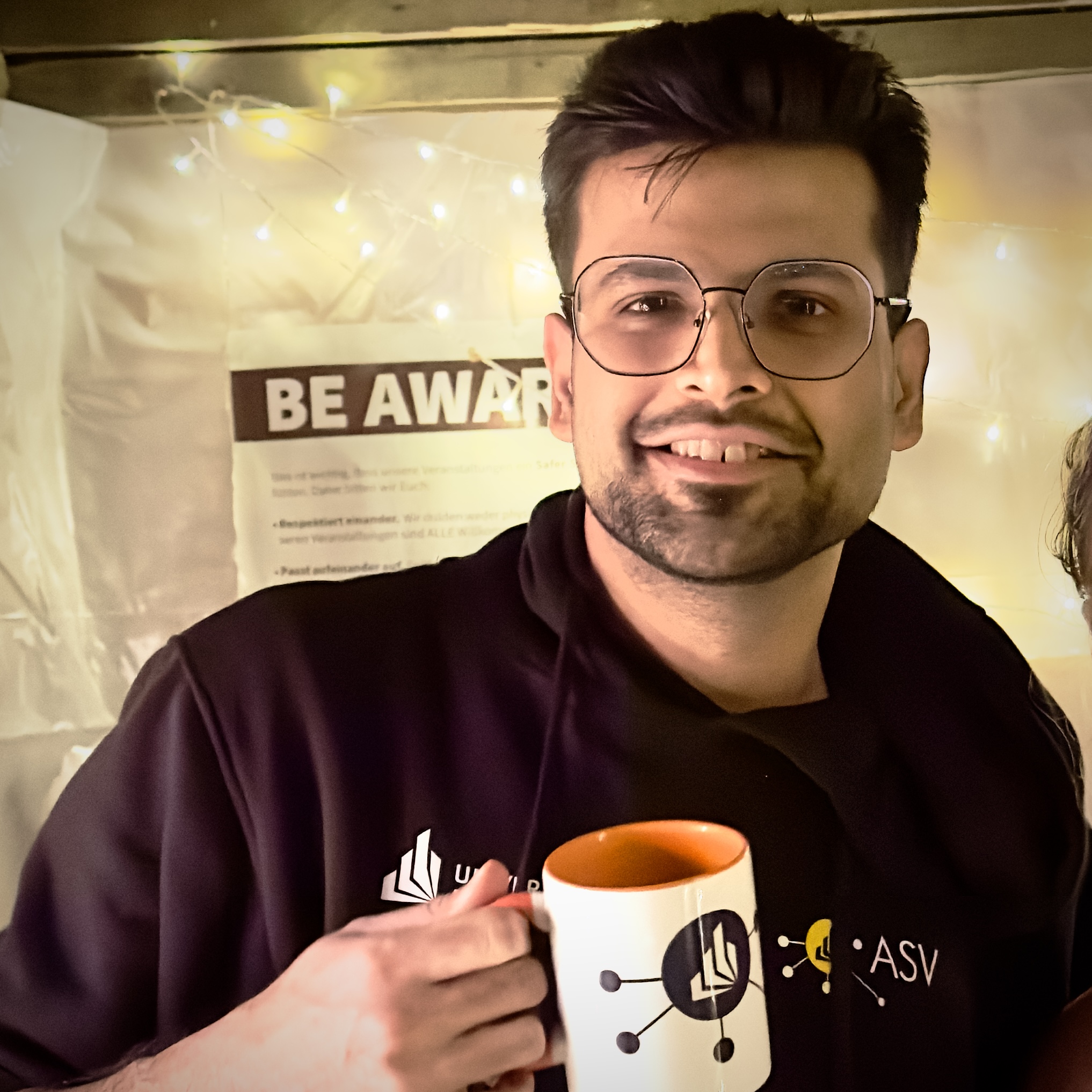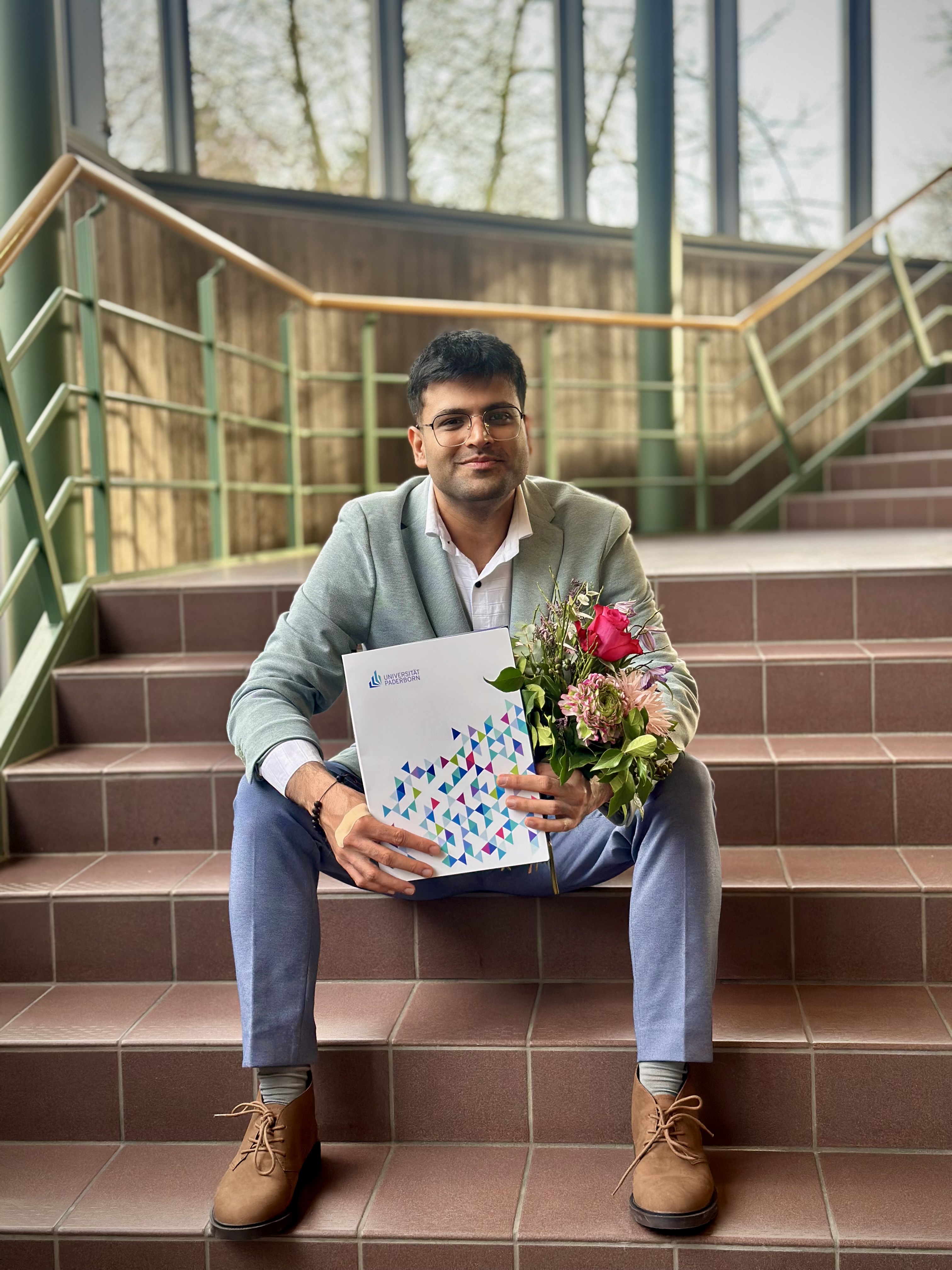
Every year, the DAAD Prize for International Students is awarded to students who, in addition to very good academic achievements, are particularly committed to society. Lakshay Khanna, a Master's student of Computer Science at Paderborn University, is one of this year's winners.
The Indian-born Computer Science graduate came to Paderborn for his Master's degree in 2019 and has since been involved not only in his studies and research, but also in numerous initiatives to promote the interests of international students. In addition to working as a student assistant at Fraunhofer IEM and the Centre for Information and Media Technology Services (ZIM) at Paderborn University, he has also been President of the International Student Union (ASV), a member of the student parliament and a Student Ambassador for the COLOURS European University Alliance.
In this interview, Lakshay Khanna talks about his academic journey from India to Paderborn University, his motivation for his extensive involvement and how international students can play an active role in shaping the university.
1. What does the DAAD award mean to you personally?
First of all, thank you very much. The DAAD Prize is a great honour for me. For me personally, it is not only a recognition of my academic career, but also of the work I have been able to do for the international student community at Paderborn University.
When I arrived here, I personally did not have much difficulty adjusting to life in Paderborn. I am an outgoing person by nature and found the city and the university to be welcoming. However, over time I realised that many international students struggled because they had limited information about support services and lacked a strong connection to these locally.
Support in English was often limited and clear guidance on how to acclimatise to a completely new environment was not always readily available. Students had to deal simultaneously with adapting to a different academic system, bridging knowledge gaps, securing housing and financial stability, and building an active social environment to avoid isolation, seclusion or even depression. I felt that these problems were not being addressed intensively enough and that structural changes were needed in the way the problems were perceived and solved.
This experience awakened in me both a sense of moral responsibility and compassion for improving my environment. At the same time, it was very motivating to see how positive outcomes can occur when students are brought together in a supportive environment. My goal has always been to pass on the same positive energy that I have personally experienced in this city, at this university and with the people here to as many students as possible.
For me, this award is therefore not only a recognition of my personal achievement, but also a recognition of the overarching idea that universities should strive for an inclusive and welcoming environment for all students.
2. What made you decide to move from India to Paderborn University for your Master's programme?
After completing my Bachelor's degree in Computer Science and Engineering in India and gaining some work experience as a software developer, I wanted to deepen my knowledge through a strongly research-oriented Master's programme and also get to know Germany, life here and the study and work culture.
Paderborn University has an excellent reputation in Computer Science and was characterised by its well-established academic environment in this field. Another important factor was the large and active international student community, which makes it easier for students from different countries to integrate and work together.
The combination of academic reputation, a strong Computer Science faculty and an international campus environment made UPB a very attractive election to continue my studies.
3. Which academic topics have influenced you the most during your studies?
Software Engineering and especially Model-Based Systems Engineering (MBSE) has been one of the most exciting topics for me during my studies so far. I originally intended to focus on machine learning during my studies and honestly had little idea about MBSE.
I took this course just to see what it was all about and realised that I was interested in the subject. It is quite surprising that even very large companies with growing market capitalisation and high profits often struggle to clearly understand or model the interactions of their internal systems and processes. Many organisations still lack a structured system model that allows them to track how requirements evolve throughout the production lifecycle. This is where MBSE comes into play. A robust system model that captures multiple interconnected processes can offer significant benefits. It helps organisations to improve their production capacity, identify bottlenecks and understand how changes in one part of the system can impact other components. From my perspective, the use of MBSE is still limited in many emerging markets, especially in manufacturing-orientated industries where it could significantly improve efficiency and system understanding.
Besides MBSE, I also really enjoyed working on UI development and system integration for a design thinking project in the field of virtual reality during my master's programme. The possibilities that VR opens up for early prototyping and exploring design concepts are very exciting. It was also a great opportunity to get to grips with programming in C#, which I always enjoy.
4. How have you been able to apply your previous experience as a software developer to your studies?
My previous experience as a software developer helped me to approach my studies and university projects with a more hands-on approach. Having previously worked in industry, I was already familiar with structured development processes, working in teams and implementing solutions in a project-orientated environment. Scrum facilitated the administration of projects (both academic and non-academic) to establish clear communication within teams, organise tasks efficiently and keep track of progress. It also helped to ensure that deliverables were channelled in the right direction early on and that productivity remained consistent throughout the development cycle.
My experience with C#.NET and responsive web apps was very useful for the UI development of my VR project, which utilised Unity.
Overall, this previous experience helped me to contribute more effectively to collaborative projects and working groups during my studies.
5. What additional skills have you gained through your work as a research assistant and working student?
Through my work as a research assistant in the InRegioFIT project at Paderborn University, I have mainly contributed to improving the support of international students and helping the university to better understand how they perceive their academic environment and the university and what they expect from it.
We have been working with the International Office team to analyse student feedback and identify areas where the University could improve its support structures, particularly in terms of preparing international students for their careers after graduation. This is an increasingly important topic as many international students are very interested in building their professional future in Germany.
I also worked as a student assistant at Two-Pillars GmbH, which was a very valuable experience as it allowed me to put my programming skills back into practice while working with model-based systems engineering (MBSE) tools (my favourite field, of course). I was involved in an interesting research-orientated project that focused on extending the capabilities and services of MBSE tools and on use cases for the deployment of MBSE in SMEs.
I had the opportunity to work with a very helpful and motivating team and it was a great learning experience to understand how these concepts are applied in engineering practice.
6. How did you manage to combine your studies with your strong commitment to international students?
It was definitely a challenge to manage my studies while also advocating for the structural improvements and long-term initiatives I wanted to push for during my time as ASV (International Students Union) President, COLOURS Student Ambassador and Student Parliamentarian at UPB.
When I became ASV President, I proposed that our work should go beyond the organisation of cultural events and aim to create a more integrated and holistic student environment where international and domestic students naturally interact with each other, rather than operating in parallel communities.
Fortunately, many students believed in this vision and joined the initiatives I proposed. Over time, a very large and motivated team of committed members emerged. This collective energy made the work both effective and highly motivating.
Balancing academic commitments and student involvement required careful time management and strong teamwork. I honestly admit that my academic, professional and personal life suffered as a result. However, I firmly believed that the moral responsibility and sense of humanity far outweighed the personal cost given the positive outcomes, and I have no regrets. I trust myself professionally and academically; the focus on internationalisation was the order of the day at the time. Through my involvement in the student representative body, I was able to understand the needs of the student body much better and contribute to improving the university environment for them.
This experience also helped me to acquire a wide range of professional skills. Managing a large team and maintaining interpersonal relationships with each team member, coordinating with university administration, negotiating with institutional stakeholders, project planning, budgeting, and achieving tangible results under time pressure have helped me develop a solid foundation in leadership, organisation, and strategic thinking.
I can confidently say that these experiences have strengthened my understanding of management and business in a way that very few academic programmes could have done in such a short period of time alongside my technical studies.
7. What challenges for international students have you noticed the most, and where have you been able to make a concrete difference?
One of the biggest challenges was the structural separation between the programmes on offer for international students and those for domestic students. For example, international students often needed a separate information point within the International Office, while the university's central service centre was primarily geared towards domestic students. Similarly, the Central Student Advisory Service (ZSB) often referred English-speaking students back to the International Office, as many of their workshops and services were only offered in German.
Whilst I believe these structures were created with good intentions, in practice they sometimes led to a sense of separation rather than integration. Of course, I was not able to implement all the solutions I had hoped for, but some could be realised, such as merging the Info Point with the Service Centre.
Another challenge concerned orientation and integration at the beginning of the degree programme. The O-Phase organised by the student councils was aimed at Bachelor's students, while most international students only joined the Master's programme. As a result, they received very little orientation beyond the academic introduction, and non-academic institutions such as the ASV often had to organise additional orientation and social activities that were limited in capacity and scope to local students of the same department, leading to segregation from the outset. Furthermore, the open-mindedness of the student councils and most student initiatives towards English-speaking international students was heavily debated.
Through discussions with the faculties and student representatives, particularly the FSMI and the Faculty of Computer Science, we were able to initiate a constructive dialogue on these issues. Today, the O-Phase for Computer Science students also includes structured activities for Master's students, which significantly improves integration from the start of the study programme. In addition, the FSMI team is committed to addressing the concerns we raised and improvements are already visible.
Another important area for improvement was the housing situation and communication with Studierendenwerk (student services association) Paderborn. There was a long list of concerns from international students regarding the housing situation, such as the allocation process, communication, the condition of the facilities and long-term maintenance issues, to name but a few. Together with the active support of the then Vice President for International Affairs, Prof. Dr. Torsten Meier, we established a working committee with Mr Ulrich Schmidt, the Managing Director of Studierendenwerk Paderborn, which meets at regular intervals to monitor communication and the handling of complaints and to discuss possibilities for further improvements.
This co-operation led to several concrete improvements in the student residences, particularly at Peter-Hille-Weg. These included the establishment of the tutoring programme, the installation of surveillance cameras, the renovation and modernisation of the laundry rooms, improved cleaning and maintenance structures, access to a common lounge, improved handover protocols and simplified move-out procedures for long-term tenants, reducing unnecessary financial burdens for students.
At the same time, the ASV was actively involved in social integration. Isolation, loneliness and even depression are real problems for many students who live far from home and do not speak German. Through regular social initiatives such as board game nights, film nights, karaoke events and intercultural activities, or simply by being part of the team, we tried to create an active and welcoming social environment where students could socialise, talk openly and make friends.
8. What role has Paderborn University played in your academic and personal development?
Paderborn University has played an important role in both my academic and personal development.
Academically, it provided me with a strong environment to deepen my knowledge in Computer Science, especially in the areas of software engineering and model-based systems engineering. The academic culture here encourages analytical thinking, structured problem solving and collaborative working, which has strengthened my technical skills. It helped me to look at problems around the globe with the opportunities that arise from a solution-oriented perspective.
However, my development at UPB was not limited to academia. Through my involvement in the student representative body, internationalisation initiatives and working with various stakeholders within the university, I gained a much deeper understanding of how institutions work and how constructive dialogue can lead to meaningful improvements.
In terms of my personal development, this trip has changed me a lot. Working closely with students from different cultures and backgrounds has made me question many of my own assumptions and prejudices and develop a much more inclusive mindset. I have learnt to approach complex problems by understanding different perspectives and yet working towards practical and balanced solutions.
In this sense, my time at Paderborn University has helped me to grow not only as a Computer Science professional, but also to develop as a person. The experience of working with diverse communities, solving real-world problems and seeing the positive impact of collaborative efforts has been one of the most valuable aspects of my time here. I have definitely developed as a person while gaining professional and entrepreneurial skills that I don't think any study programme in these areas could have taught me in such a short time.
9. To what extent do your studies, research and campus life benefit from international diversity?
International diversity is of enormous value to universities. When students from different cultural and educational backgrounds come together, they bring different perspectives on understanding problems and finding solutions.
In academic discussions and research projects, this diversity often leads to more creative thinking and more comprehensive solutions as problems are approached from different angles. It also encourages students to question assumptions and learn from each other. For example, in a user experience project, a local student might focus on data protection and structured logic, while a student from India would focus on mobile accessibility for low-bandwidth areas. By combining these perspectives, the team is developing a product that is not only technically robust, but also globally scalable. Something that would not be so obvious in a homogeneous group.
At the campus level, international diversity helps to create a more open and globally connected academic environment. Students develop intercultural competence, empathy and adaptability - skills that are becoming increasingly important in both professional and social contexts.
In my experience at Paderborn University, the genuine interaction and collaboration between international and local students enriches not only the academic environment but also the social life on campus, helping to build a stronger and more inclusive university community.
10. What are your plans after your master's programme?
After completing my Master's degree, I would like to work in an environment where I can apply my strong technical background together with the interpersonal and organisational skills I have developed through my university experience.
I am particularly interested in roles that combine technical expertise with management, systems thinking and business understanding. At the same time, I would definitely like to delve deeper into the field of model-based systems engineering (MBSE). I believe that there is still a lot of untapped potential for MBSE, especially in developing countries, where the manufacturing industry could benefit significantly from more structured approaches to system modelling.
I also want to continue my commitment to the common good. What drives me most is the opportunity to contribute to building a better world - maybe it's just a drop in the ocean, but there should be an incentive for people.
Beyond my professional goals, I want to continue to contribute in some way to the common good or community development. What drives me the most is the opportunity to contribute to building a better world, even on a small scale. It may only be a drop in the ocean, but I believe that the opportunity to make a positive difference should always remain an important incentive for us as individuals.