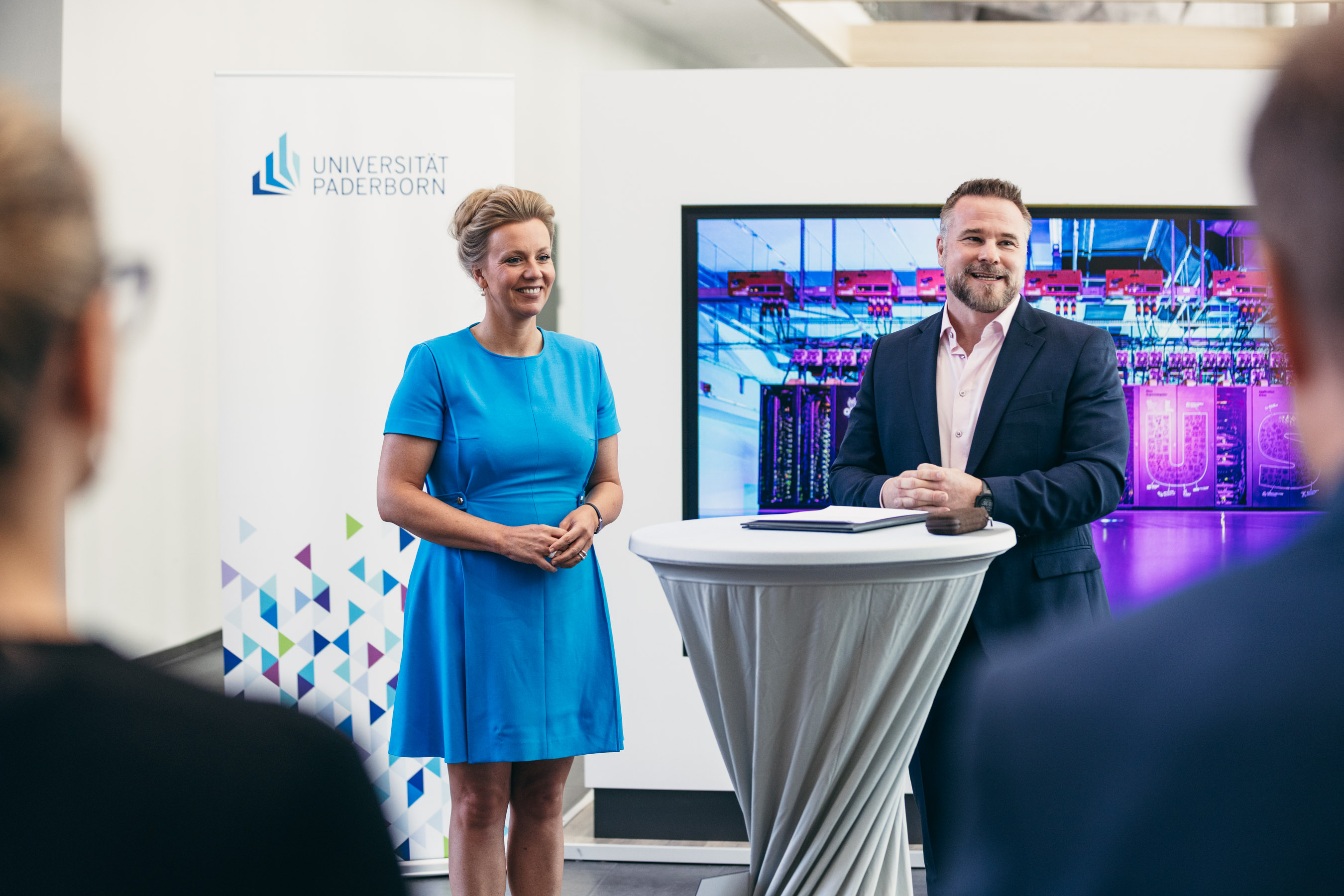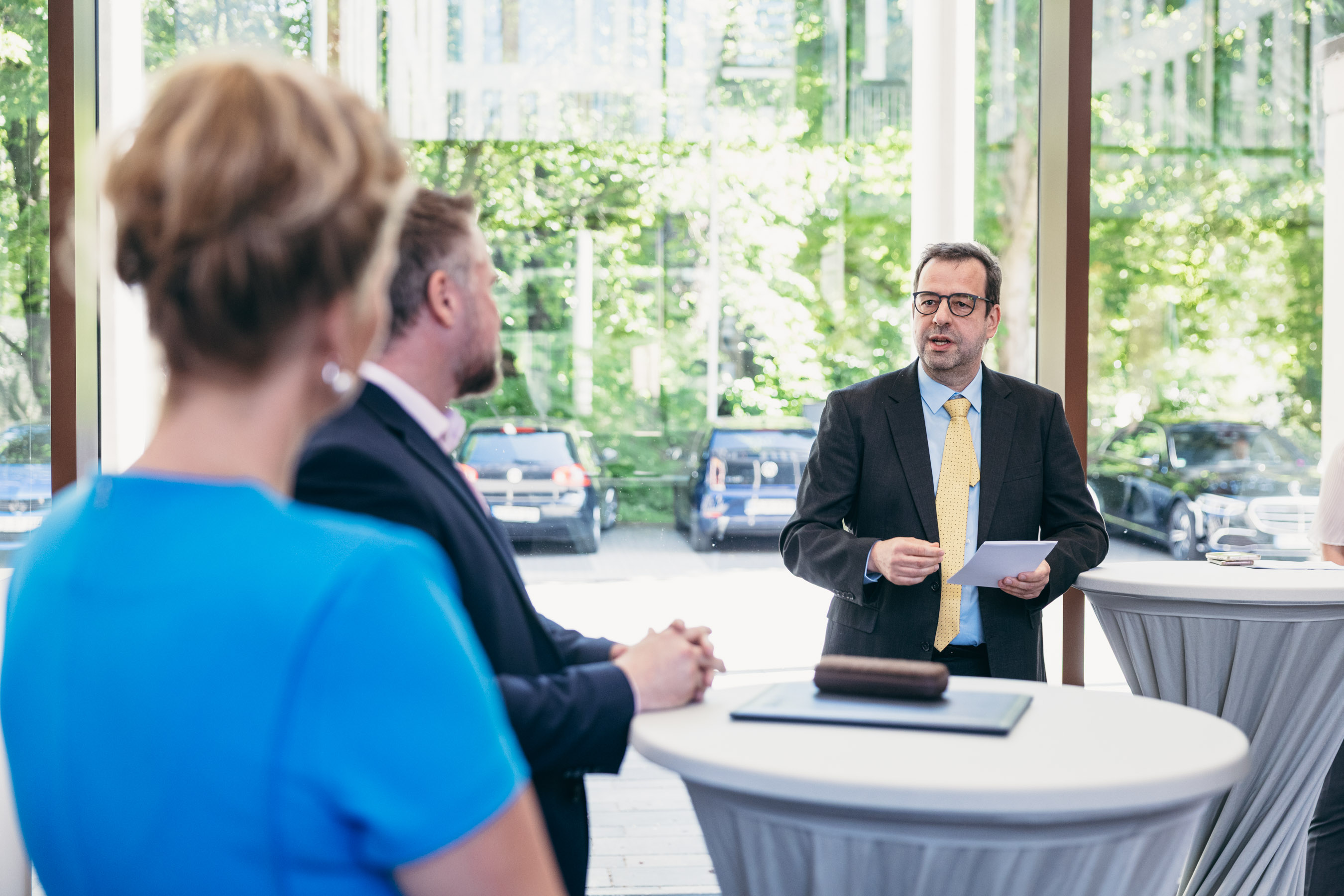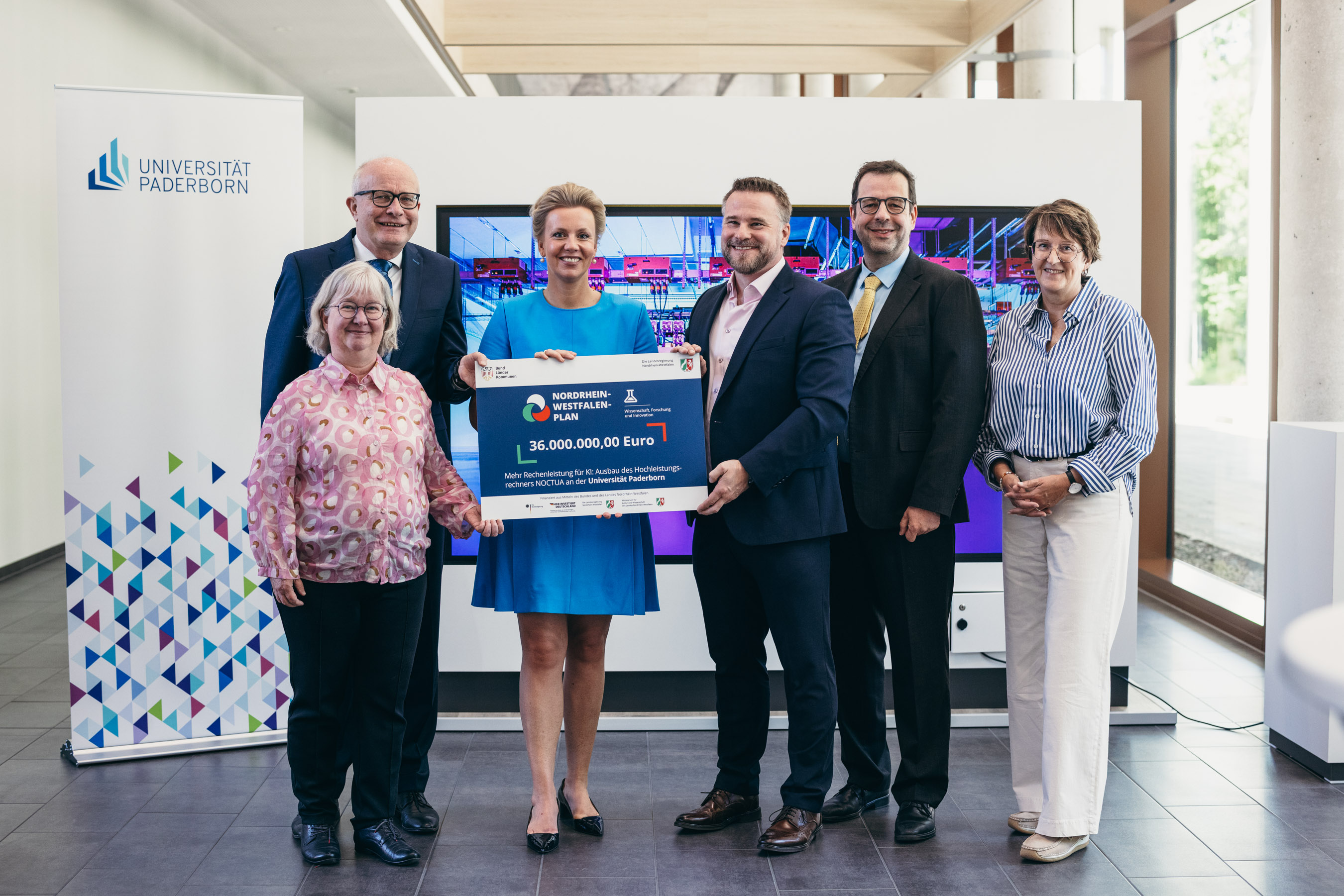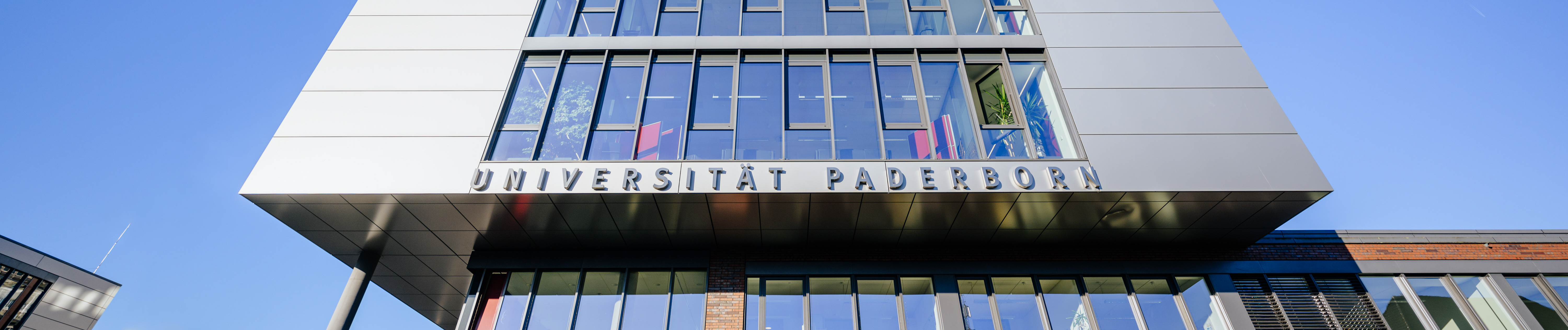
Quantum computing, cloud services, artificial intelligence: data centres are of crucial importance when it comes to storing, processing and providing large amounts of data. They not only form the basis for state-of-the-art IT infrastructures, but also play a major role in digital sovereignty. With Noctua 2 and Otus, Paderborn University has two supercomputers that make it a member of the National High Performance Computing Centres (NHR) network. However, as the building housing the computers has now reached its supply limits, the computer centre in Building X is being expanded. The university is also working on an application for the next expansion stage as part of the "NRW Plan for Good Infrastructure". NRW Science Minister Ina Brandes presented a letter of intent for this on Thursday, 28 May.
"Artificial intelligence is the raw material in the digital age and computing power is the tool we need to utilise this new raw material sensibly. Paderborn is one of the leading high-performance computing centres in Germany. We are consistently investing the money from the NRW plan for good infrastructure in the major topics of the future and the outstanding facilities at our universities. This will also take Paderborn University's supercomputers to a new level. This will allow research data to be utilised more quickly and AI systems to be further developed. After all, excellent research and teaching need excellent infrastructure," said Culture and Science Minister Brandes.
The "North Rhine-Westphalia Plan for Good Infrastructure" is the largest infrastructure and investment programme in the state's history. Over a period of twelve years, the state government is making a total of around 31.2 billion euros available for investment. Around 21.3 billion euros of this will be allocated to local authorities, while almost 10 billion euros will be invested in the state's infrastructure. 36 million will go towards the expansion of the high-performance computing centre at Paderborn University.
"The expansion is a further step on the way to a future-proof and sustainable IT infrastructure at the highest level," says Professor Dr Matthias Bauer, President of the University. A total of 140,000 compact processor cores have been working on highly complex tasks in the "Noctua 2" supercomputer since 2022. "Otus" even has twice the computing power. It is used to work on issues such as quantum research, materials science and sustainable energy technology.
The high-performance computing centre is operated by the "Paderborn Center for Parallel Computing" (PC2), an interdisciplinary research institute at the university. "The extension stages of Building X, which was built for Noctua, were planned from the outset. The cooling and fire protection concepts, power supply and office space are also geared towards this. However, these initially planned expansion stages have been almost completely utilised by the installation of the Noctua 2 and Otus computer systems and the Otus expansion that will take place towards the end of this year. The state funding enables the urgently needed expansion of power supply and cooling to create more capacity for research data and AI systems. It also allows us to generate expansion reserves for future developments," explains Professor Dr Christian Plessl, Head of PC2.
Sustainability also played a special role in the construction of the building: the electricity comes from renewable sources and is thereforeCO2-free. The hot water cooling system is highly efficient and the waste heat is used to heat various buildings. "With this expansion, Paderborn University is consistently combining the highest computing power with sustainable energy efficiency, making it clear that cutting-edge research and climate protection can go hand in hand," says Professor Bauer.
More about high-performance computing at Paderborn University.