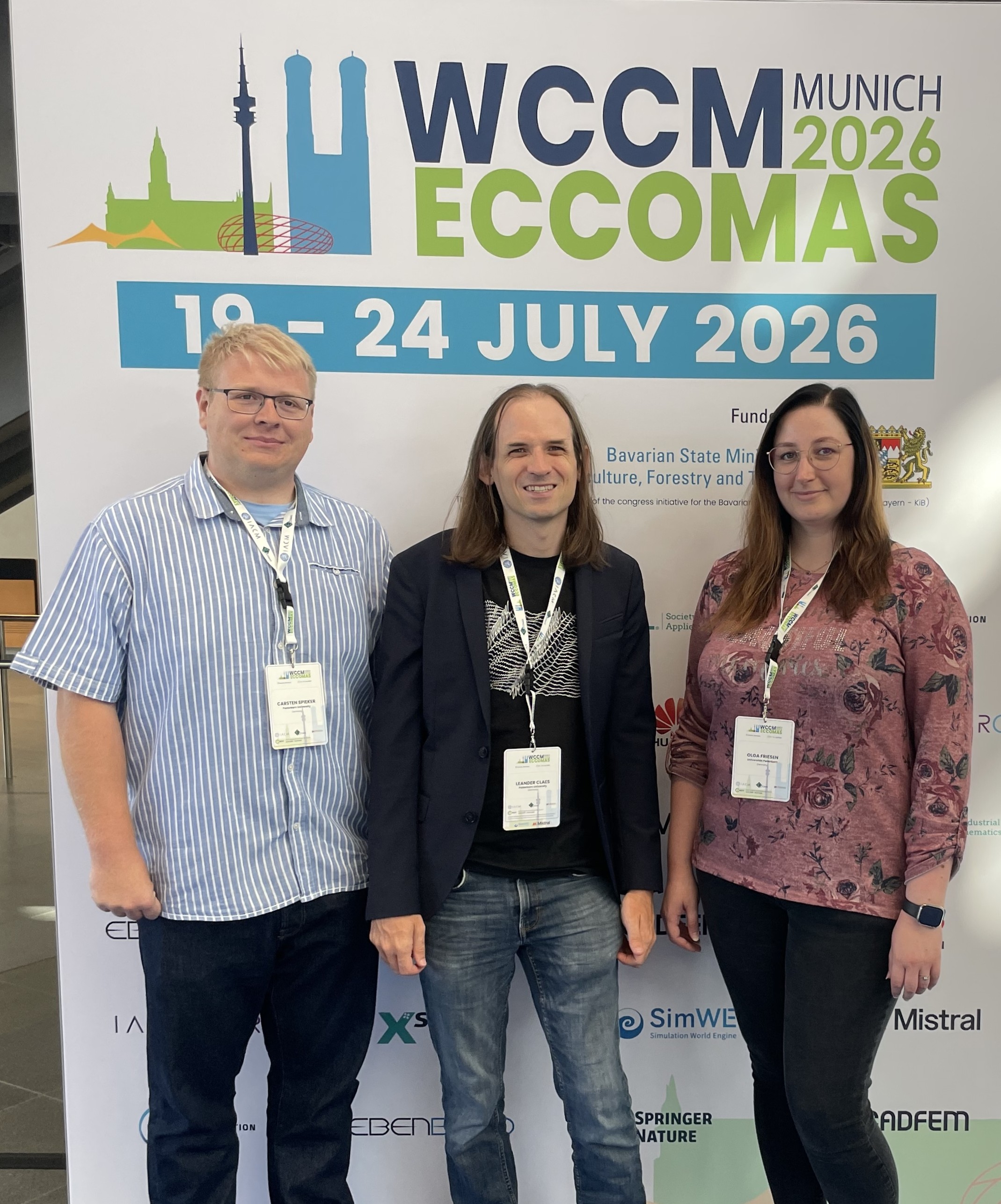
Teilnahme an der WCCM–ECCOMAS 2026
Das Fachgebiet Elektrische Messtechnik (EMT) nahm vom 19. bis 24. Juli 2026 an der 17th World Congress on Computational Mechanics (WCCM) & 10th European Congress on Computational Methods in Applied Sciences and Engineering (ECCOMAS) in München teil. Die WCCM–ECCOMAS zählt zu den weltweit größten und bedeutendsten Konferenzen im Bereich der Computational Mechanics und der numerischen Methoden in den Ingenieurwissenschaften. Das wissenschaftliche Programm umfasste mehr als 4.600 Fachvorträge in 344 Minisymposien sowie zahlreiche Plenarvorträge und bot eine Plattform für den internationalen Austausch zwischen Wissenschaft und Industrie.
Im Rahmen des Minisymposiums „Multiphysical Modeling and Characterization of Ferroelectric Materials – State of the Art and New Challenges“ präsentierte Olga Friesen die aktuellen Forschungsergebnisse in einem Vortrag mit dem Titel „Quantitative Modelling of Dynamic Nonlinearity in Piezoelectric Components“. Die Kurzfassung des Beitrags finden Sie untenstehend. Das Minisymposium brachte Forschende zusammen, die sich mit der Modellierung, Charakterisierung und Simulation ferroelektrischer Materialien beschäftigen, und bot die Gelegenheit, aktuelle Entwicklungen sowie zukünftige Herausforderungen in diesem Forschungsgebiet zu diskutieren.
Kurzfassung
The modelling of piezoelectric components is particularly challenging due to the interacting electric and elastic fields. For a quantitative representation of the physical behaviour of these components numerous material parameters need to be known accurately. Several studies have successfully explored possibilities to determine these parameters under assumption of linear properties. However, there are several applications of piezoelectric components, for example ultrasonic welding and cleaning, where nonlinear effects, such as shifting resonance frequencies and the generation of harmonics, are observed. This contribution describes an approach to reproduce these effects in numerical field simulations and quantify the nonlinear properties of a physical sample (a piezoceramic ring).
Prerequisites for this method are that the nonlinear effects can be observed and quantified in measurements and that the specific type of nonlinearity is implemented in a simulation environment. To observe the nonlinear behaviour of the sample, it is driven at elevated voltages in and around its resonance frequencies and electrical quantities (i.e. voltage and current) as well as the surface displacement, are recorded. For the present study, nonlinear effects are considered by assuming a polynomial relation between strain and stress in the elastic part of the piezoelectric material model. This is implemented in a finite element framework, solving the electrostatic as well as the nonlinear elastic wave equation for a two-dimensional axisymmetric model of the sample. The parameters of the linear part of the material model are identified using the established methods based on the electrical impedance spectrum of the sample.
Estimates for the nonlinear parameter are derived exploiting the acoustoelastic effect by statically biasing the sample, identifying the linear parameters in the biased state. These initial estimates are refined by reproducing the nonlinear measurements using the model and adapting the nonlinear parameter to match the model's behaviour to the observations.